
This article measures AI video generation speed and memory use on an RTX 5060 Ti 16 GB with 64 GB RAM, providing a practical reference for small studios and businesses planning a low-cost AI workstation, deploying local uncensored models, and designing a video production workflow. The aim of choosing uncensored models is to reduce unnecessary content restrictions and allow more creative freedom in storytelling, character design, and visual expression.
We tested four video models already installed on the workstation in ComfyUI, using one sailboat prompt to generate 1280 × 704, 24 fps clips lasting about five seconds, with audio. All four completed both runs, but the waiting times differed substantially.
LTX-2.5 Distilled NVFP4 took 98.970 seconds on the first request after restarting ComfyUI and 71.272 seconds on a second request with the same prompt and a different seed. Under this protocol, LTX-2.5 Uncensored v1.1 Q4_K_M took about 2 minutes 12 seconds on its second run, 10Eros H3 Turbo Beta3 about 5 minutes 5 seconds, and H3 HQ about 15 minutes 23 seconds.
Test system: 16 GB VRAM and 64 GB system RAM
| Test date | November 2, 2026, Taipei time |
|---|---|
| CPU | Intel Core i7-11700 |
| GPU | NVIDIA GeForce RTX 5060 Ti 16 GB |
| System memory | 64 GB RAM; approximately 62.56 GiB reported by Linux |
| Platform | Linux; NVIDIA driver 615.71.09 |
| ComfyUI | 0.43.0; ComfyUI-GGUF loader for the GGUF model |
| Python / PyTorch | Python 3.11.14 / PyTorch 2.10.0+cu130 |
| Execution settings | Batch size 1; ComfyUI launched with --reserve-vram 1 |
System RAM and GPU memory are different resources. The workflow must load model files, run a text encoder, decode video and audio, and move model data between CPU memory and the GPU. Knowing that a graphics card has 16 GB does not fully describe the execution environment.
That is why the title also specifies 64 GB RAM: it is the installed capacity of this test machine, not a demonstrated minimum requirement. We did not repeat the test with 32 GB or 16 GB RAM, so these results cannot predict whether a smaller memory configuration would maintain the same speed.
The four models and their actual components
Both LTX workflows use the Heretic Gemma4 12B NVFP4 text encoder. Both H3 workflows share Qwen3-VL-32B NVFP4 AWQ. This reduces encoder-related variation within each family, but does not make the different main models equivalent experimental conditions.
| Short name | Actual version | Sampling settings | Text encoder |
|---|---|---|---|
| LTX Distilled NVFP4 | LTX-2.5 22B Distilled NVFP4 | 8 steps; Euler Ancestral; manual sigma schedule | Heretic Gemma4 12B NVFP4 |
| LTX v1.1 Q4_K_M | LTX-2.5 22B Uncensored v1.1 Q4_K_M (GGUF) | 8 steps; Euler / simple | Heretic Gemma4 12B NVFP4 |
| H3 Turbo Beta3 | 10Eros-Max H3 Turbo Hybrid Beta3 NVFP4 | 6 steps; ER-SDE / simple | Qwen3-VL-32B NVFP4 AWQ |
| H3 HQ | 10Eros-Max H3 FL2VA NVFP4 HQ | 20 steps; Euler / simple | Qwen3-VL-32B NVFP4 AWQ |
Both LTX workflows use video and audio CFG of 1, BF16 video and audio VAEs, and tiled video decoding. H3 uses video/audio shifts of 12/3, an FP16 video VAE, an FP32 audio VAE, and ordinary video decoding.
The v1.1 workflow did not use its author’s Uncensored Gemma INT8 encoder; it shared Heretic NVFP4 with the other LTX workflow. The H3 Turbo model is specifically Beta3 NVFP4, not Beta5 TURBO Hybrid W4A8 Optimized.
Model and quantized-weight sources: DeepBeepMeep LTX Distilled NVFP4; ChrisColeTech v1.1 Q4_K_M; JCorcho Turbo Beta3 quantization; and DmitryDB H3 HQ quantization. For family background, see Lightricks LTX-2.5, the official MiniMax model card, and TenStrip 10Eros-Max.
Method: one scene, two runs per model
This was text-to-video generation, with no reference photo or video. The prompt describes a small red sailboat moving across a lake at sunrise, with a gentle tracking pan, water sounds, and distant birds. All four models received exactly the same text:
A cinematic shot of a small red sailboat gliding slowly across a calm lake at sunrise. The camera pans gently to follow it. Soft warm light, realistic reflections and ripples. Audio: gentle water lapping and distant birds, unscored footage, no speech.
- Resolution: 1280 × 704 at 24 fps, generated directly at that size, without a preceding 480p generation and upscale.
- Duration: LTX outputs contain 121 frames, approximately 5.042 seconds; H3 outputs contain 124 frames, approximately 5.167 seconds. Each workflow uses an accepted frame count. H3 has about 2.48% more frames, so durations are not identical.
- First run: ComfyUI was restarted for each model, using seed 12345. Timing began after the service was ready. The operating system’s file cache was not cleared.
- Second run: the prompt and workflow stayed the same, with seed changed to 12346. Sampling ran again, while model-loader and text-encoding caches could be reused.
- Full elapsed time: measured from just before submitting the workflow until successful completion, including loading and encoding required by that request, sampling, video/audio decoding, and saving the output. ComfyUI service startup time is excluded.
- Postprocessing: no upscaling, interpolation, Detailer, prompt enhancement, or extra LoRAs.
The execution order was LTX Distilled NVFP4 → LTX v1.1 Q4_K_M → H3 HQ → H3 Turbo Beta3, with each model’s two runs performed consecutively. Order was not randomized, and there were no additional repeated trials.
The second run means generating another seed from the same prompt. It does not measure the time needed for a new prompt, a fresh application launch, or reloading all components. Because cache conditions differ, the two observations are reported separately rather than averaged into a claimed steady-state speed.
Full generation time: about 71 seconds for LTX NVFP4’s second run
| Model | First run | Second run | Second run, rounded | Second-run time relative to LTX NVFP4 |
|---|---|---|---|---|
| LTX Distilled NVFP4 | 98.970 s | 71.272 s | 1 min 11 s | 1.00× |
| LTX v1.1 Q4_K_M | 166.567 s | 131.509 s | 2 min 12 s | 1.85× |
| H3 Turbo Beta3 | 330.354 s | 305.432 s | 5 min 5 s | 4.29× |
| H3 HQ | 951.493 s | 923.033 s | 15 min 23 s | 12.95× |
Ratios compare complete second-run workflows, not isolated architecture or quantization efficiency at matched step counts and quality. Minute/second labels are rounded; calculations use the original elapsed seconds.
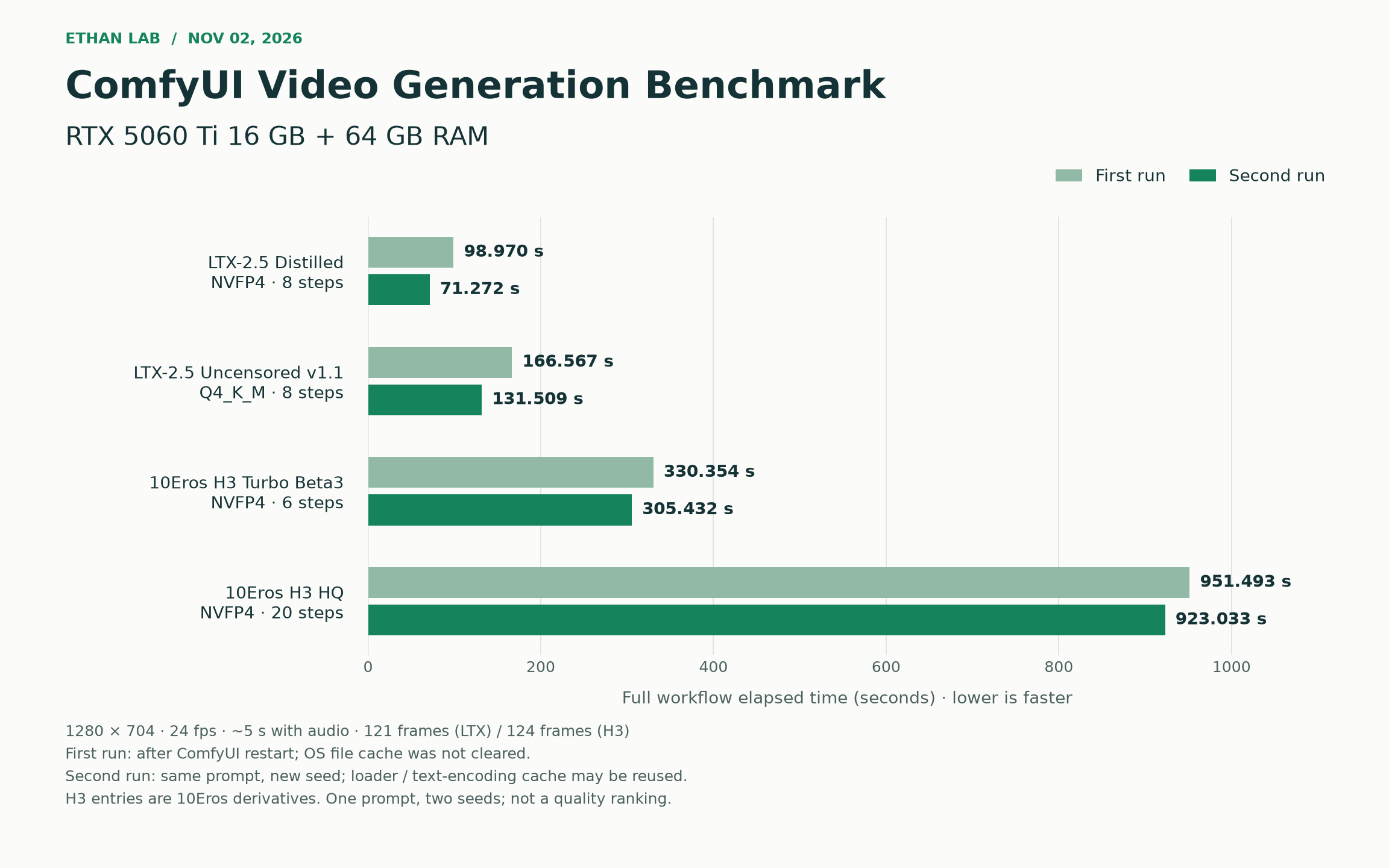
LTX Distilled NVFP4 offered the shortest iteration wait in this workload. The v1.1 Q4_K_M second run took about 60 seconds longer, or 1.85 times as long. Although both use eight steps, their main weights, loaders, samplers, and quantization formats differ. The entire gap cannot be attributed to Q4_K_M alone.
The two H3 workflows also differed considerably: Turbo Beta3 took 305.432 seconds versus HQ’s 923.033 seconds. Turbo reduced elapsed time by about 66.9%, with HQ taking 3.02 times as long. This comparison includes six versus twenty steps, different main weights, and different samplers. It does not demonstrate equal quality or establish that the version named HQ produces better-looking results.
Where does the waiting time go?
Full generation takes longer than sampling because the workflow also decodes and saves the clip. Separating the second-run sampling node gives a better view of the elapsed time.
| Model | Full workflow | Sampling node | Remaining elapsed time |
|---|---|---|---|
| LTX Distilled NVFP4 | 71.272 s | 56.024 s | 15.248 s |
| LTX v1.1 Q4_K_M | 131.509 s | 114.889 s | 16.620 s |
| H3 Turbo Beta3 | 305.432 s | 254.510 s | 50.922 s |
| H3 HQ | 923.033 s | 872.186 s | 50.847 s |
The sampling measurement is wall-clock time for SamplerCustomAdvanced, including model transfers and offloading, rather than pure GPU kernel time. The remainder is not a standalone VAE benchmark: it also includes other nodes, output, and workflow overhead.
H3 HQ still spent approximately 872 seconds in the sampling node on its second run, so its long wait is not simply a first-time loading cost. Other sparse-attention implementations and additional acceleration methods were not tested, and this result is not a speed ceiling for H3 in all software.
VRAM was nearly full, while Q4_K_M used more system RAM
The following are the highest observed values across each model’s two runs. Whole-GPU memory was sampled approximately once per second with nvidia-smi. RAM measurements are the ComfyUI process’s RSS: pages resident in physical memory at the time of observation.
| Model | Highest observed whole-GPU memory | Highest observed ComfyUI process RSS |
|---|---|---|
| LTX Distilled NVFP4 | 15.17 GiB | 13.27 GiB |
| LTX v1.1 Q4_K_M | 14.85 GiB | 24.60 GiB |
| H3 Turbo Beta3 | 15.16 GiB | 10.90 GiB |
| H3 HQ | 15.19 GiB | 13.22 GiB |
All four workflows approached the available capacity of this 16 GB card. LTX v1.1 Q4_K_M had slightly lower GPU usage, but its process RSS reached about 24.6 GiB, above the other three. Lower GPU memory use does not necessarily mean lower system RAM use for the complete workflow; loading and execution paths matter as well.
These measurements have limits. GPU figures include baseline use by the whole card. RSS covers one process, including mapped pages; it is not total system memory, all file cache, or a swap measurement. One-second sampling may miss short peaks. GPU and RSS maxima may occur at different times, so they cannot simply be added into an instantaneous total requirement.
This 64 GB RAM system completed all eight outputs. A peak process RSS of 24.6 GiB alone does not guarantee that a 32 GB machine has enough headroom during loading, with different cache conditions or background applications. It also does not prove that every user must upgrade to 64 GB.
Actual clips: the four second-run outputs
All four clips below are the original second-run MP4 files, using seed 12346. There was no additional upscaling, interpolation, or loudness normalization. Some audio is quiet. Players do not autoplay. The same numerical seed does not imply matching composition or equivalent noise across different models.
LTX Distilled NVFP4|71.272 s
LTX v1.1 Q4_K_M|131.509 s
H3 Turbo Beta3|305.432 s
H3 HQ|923.033 s
All eight files were checked for resolution, 24 fps, frame count, and an audio stream, and their audio was not entirely silent. First, middle, and last frames were inspected for each output, with no black or noise-only results. These were basic output checks, not scores for aesthetics, natural motion, audiovisual synchronization, or sound quality.
The scene contains a sailboat and a lake. Reference portraits, face swapping, facial identity consistency, and long-clip stability were not tested. These speed results cannot establish which model better preserves a person’s appearance. Uncensored, Heretic, and HQ are version names; this scene did not test the extent of uncensoring or demonstrate a quality advantage.
Component compatibility matters when reproducing the test
The test reused existing WanGP weights, but placing a main-model file in ComfyUI’s model directory was not enough for this setup. The existing LTX NVFP4 file needed ComfyUI quantization markers and its corresponding video/audio connector components. The audio VAE also needed to be combined with the vocoder into a complete decoding component.
ComfyUI-specific compatibility copies were created while preserving the original WanGP files. Hash checks verified that the existing tensor payloads were unchanged; the main model was not requantized or converted to higher precision. This preparation enables correct loading of the existing components and is not an additional quality or speed enhancement.
Model filenames and detailed settings
ltx-2.5-22b-distilled_diffusion_model_nvfp4.safetensors: 8 steps; sigmas1.0, 0.99375, 0.9875, 0.98125, 0.975, 0.909375, 0.725, 0.421875, 0.0.ltx25_uncensored_v1.1-Q4_K_M.gguf: GGUF loader; Euler / simple; 8 steps; denoise 1.10Eros_Max_h3_TURBO-hybrid_beta3_nvfp4.safetensors: ER-SDE / simple; 6 steps.10Eros_Max_H3_FL2VA-NVFP4-HQ.safetensors: Euler / simple; 20 steps.- LTX tiled decoding: tile size 512, overlap 64, temporal size 64, temporal overlap 16.
- ComfyUI was fixed at 0.43.0. No second latent-upscaling stage or diffusion video decoder was used.
Download the CSV with all eight requests. It includes full elapsed seconds, sampling-node seconds, GPU memory and process RSS observations in MiB, resolution, frame count, seeds, steps, and samplers. GiB values in the table are MiB divided by 1024 and rounded.
Which setup is practical on this workstation?
If minimizing the wait while trying compositions and seeds is the priority, LTX-2.5 Distilled NVFP4 was the fastest of these four tested workflows: about 99 seconds on the first run and 71 seconds on the second. That finding applies to this scene and workflow, without evaluating portrait quality or other untested aspects.
For examining v1.1’s output characteristics, Q4_K_M also completed clips on this 64 GB system. Here, the trade-off was a second-run time of about 132 seconds and higher ComfyUI process RAM usage. It was not the speed winner, but that does not rule out other reasons to use it.
For trying the MiniMax H3 family locally, 10Eros Turbo Beta3 offered the shorter wait of the two H3 configurations: about five minutes on its second run, versus roughly fifteen minutes for HQ. Whether a particular image is worth another ten minutes requires checking outputs for your own subject matter. Two sailboat seeds cannot settle that choice for every production scenario.
Local video model selection should consider the main weights, text encoder, decoding path, sampling steps, 16 GB VRAM, and 64 GB RAM together. This test provides a concrete starting point: all four installed models completed audio-video clips, with LTX Distilled NVFP4 offering the shortest generation wait on this RTX 5060 Ti workstation.


